

Davey Lopes ignited four pennant-winning Los Angeles Dodgers teams between 1973 and 1981, providing consistency and leadership as the team’s leadoff man and second baseman. The scrappy, no-nonsense East Coast native twice led the National League in stolen bases, made four All-Star teams, won a Gold Glove Award, and earned a World Series ring. In baseball parlance, Lopes was a gamer. A victory player. A man who made overcoming the odds a habit beginning at a young age.
Childhood and High School Career
Davey Lopes was born on May 3, 1945, and grew up in East Providence, Rhode Island. His father, whose family emigrated from Cape Verde—a group of volcanic islands off the West African coast—died when Davey was a toddler. A stepfather came and went. For the most part, Davey’s mother, a woman of Irish descent named Mary Rose, raised Davey and his nine siblings on her modest income as a housekeeper in a three bedroom, one-bath tenement. Davey used a bat, not just to hit baseballs, but to stamp out roaches that infested the building.
Sports provided a way for Davey to pass the time and stay out of trouble, although he did once spend a night in jail for shoplifting. “If it hadn’t been for sports, there’s no telling what I’d be or where I’d be,” he said later. “All I had to do was step off the porch to a choice of all the things you associate with a ghetto … drugs, vice, stealing.”
Lopes lived in a predominantly Black neighborhood. He attended La Salle Academy, a predominantly white private high school in Providence. Because he had light brown skin, thick black eyebrows, and curly black hair, some people assumed he was Hispanic. Later, when he entered professional baseball, people would ask, “What the hell are you?”
“Growing up mixed race, even as a kid, you have a tough time identifying where you fit in,” said Lopes. “When you’re deciding what you are, you’re caught in between. When you look in a mirror, what do you see looking back at you? With me, it’s a person of color.”
Lopes’s first love was basketball. At La Salle, he led an up-tempo offense as an all-state point guard. He played center field for the baseball squad, although outdoor practices and games were limited because of New England’s inclement spring weather. After graduating high school, Lopes spent a year unloading boxes at a clothing store, keeping in shape by playing basketball in a nineteen-and-under Catholic league. His mother pushed him to go to college. When Davey told her that planned to join the military instead, she slapped him across the face.
Two months later, he was enrolled at Iowa Wesleyan College in Mount Pleasant, Iowa, where a former Providence-area basketball coach, Mike Sarkesian, had become athletic director. Sarkesian, who had also grown up poor, not only recruited Lopes to play both basketball and baseball, but he also became a father figure. “He could relate to my problem, my environment,” said Lopes. “The drive, the determination not to give in to the ghetto, to make something of my life, stems from my relations with him.”
College Career
At Iowa Wesleyan, Davey Lopes earned first-team all-conference honors and received honorable mention from the NAIA for his basketball prowess. But the five-foot-nine, 170-pound guard realized that he had a more realistic chance of playing professional baseball. Although he wasn’t an imposing presence in the batter’s box, his small but sinewy frame packed a surprising amount of power. As a sophomore, he slugged nine home runs in 19 games.
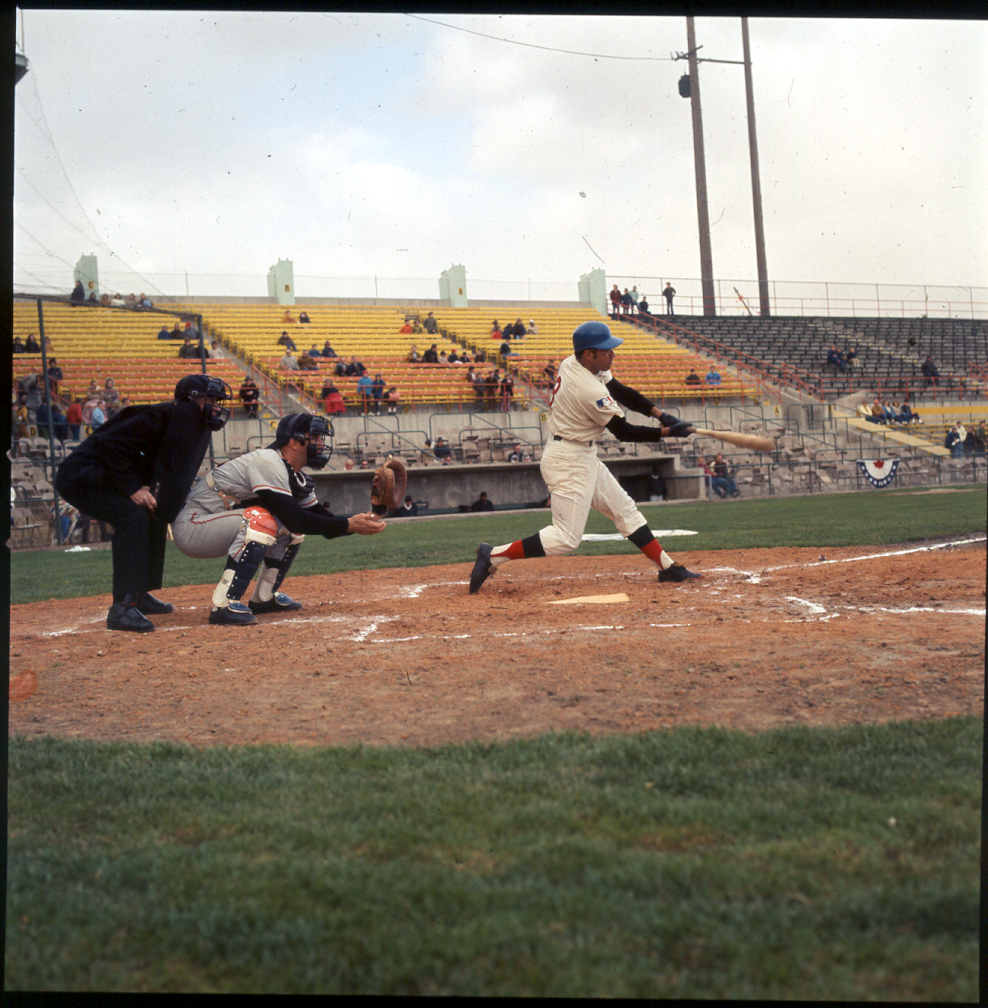
At the end of Lopes’s sophomore year, Sarkesian left Iowa Wesleyan to become athletic director at Washburn University in Topeka, Kansas, where he recruited Lopes a second time. “Mike could sell air conditioners to Eskimos,” said Lopes. “He convinced me that it would be my best chance to get signed baseball-wise. I didn’t know that it was going to be my ticket, but no one else was recruiting me. Mike was offering me the opportunity to go to a bigger school, and the brand of baseball was a little better, a little more difficult.”
Lopes displayed five-tool ability as a center fielder for the Ichabods. As a junior, he hit .380 with nine homers and 20 stolen bases in 29 games. “He was a hell of an athlete,” said teammate Gene Reardon, who remembered Lopes as quiet and a bit standoffish. “We played a lot of pickup basketball. In fact, I think he’s the guy who cut my eyelid and sent me to the hospital.”
Bernie Bianchino played football at Washburn and worked out briefly with the baseball team as a freshman. He decided to stick to football after watching Lopes take batting practice. “Lopes hit about one out of every three pitches over the fence,” recalled Bianchino. “He had unbelievable wrist action with the bat. I was six-foot-two, 235 pounds, and I could hit maybe one out of ten pitches over the fence. I realized pretty quickly that baseball wasn’t going to be my sport.”
Lopes’s classmates were just as mesmerized by his ability on the basketball court. He possessed quickness, excellent coordination, and absurd jumping ability. His physical attributes, coupled with his toughness, helped him become a shutdown defender. “Davey was a defensive guru,” said Washburn alum Mark Elliott, whose father, Larry Elliott, coached Lopes on Washburn’s baseball team. “He could really defend because he was quick and strong. He was short but stout.”
The San Francisco Giants selected Lopes in the eighth round of the 1967 June Amateur Draft, but he turned down their offer on the advice of Sarkesian, who told him he could improve his draft position and earning potential by waiting. Lopes returned to Washburn for his senior year, playing one final season of basketball while earning a degree in elementary education.
Because he didn’t sign with the Giants, Lopes entered the secondary phase of the next draft the following January. Although the best talent typically came out of the more expansive June pool, a few future stars, including Carlton Fisk and Ken Singleton, were January signees during the few years of the draft. The Dodgers, having signed only one future big leaguer from their first two January drafts, selected Lopes in the second round. After the conclusion of the college basketball season, Dodgers scout John Keenan, a fellow Washburn alumnus, signed him for a bonus of $10,000.
That June, the Dodgers adjusted their draft strategy and went all-in on position players. They hit the jackpot, acquiring a pool of prospects that included Steve Garvey, Ron Cey, Bobby Valentine, Bill Buckner, and Tom Paciorek. The class of ’68 remains to this day the most talented of all time.
Professional Career
Davey Lopes spent his first two years of pro ball in Single A with the Daytona Beach Dodgers in the Florida State League. He was good but not great, hitting .264 with 14 homers and 58 steals across the 1968-69 seasons. In 1970, he jumped to the Triple-A Spokane Indians, serving as a reserve outfielder behind Bill Buckner, Bill Russell, and Tom Paciorek on manager Tommy Lasorda’s squad. When not riding the bench, Lopes was often away for Army Reserve duty. In 100 games, he posted a .262 batting average, belted six home runs, and helped Spokane win the Pacific Coast League title.

A year later, Lasorda, who saw no path to regular playing time for Lopes as an outfielder in Los Angeles, suggested he convert to second base. Lopes initially pushed back on the idea but eventually came around. It was a wise decision that propelled him to the big leagues, beginning in 1972.
Lopes helped lead the ’74 Dodgers to their first pennant in eight years. He, along with Cey, Garvey, and Bill Russell, formed an infield that would play together for an unprecedented eight-plus seasons. In ’75 and ’76, Lopes led the NL in stolen bases with 77 and 63, respectively.
In 1978, the Dodgers appointed Lopes the fifth team captain in team history, following an impressive lineage of Pee Wee Reese, Duke Snider, Maury Wills, and Willie Davis. Eight years earlier, Lopes had been as quiet as a mime during his first season in Spokane. Over his next two seasons in Triple A, he gradually came out of his shell at the urging of Lasorda, who saw leadership potential in the youngster from East Providence. “He instilled a lot of his own personality in me,” Lopes said in 1978, “both in my approach to baseball and in my personal life.”
Once he had a few years of big-league experience under his belt, Lopes emerged as a leader on the Dodgers. When Dusty Baker missed a cutoff man shortly after joining the team in ’76, Lopes approached him and said, ‘We don’t play that way.” Baker responded, “Hey, I almost threw him out.” Lopes repeated himself firmly, “We don’t play that way.” Baker, who had never had a teammate talk to him that way, looked up and saw the whole team coming to back up the diminutive second baseman. In his first season as captain, Lopes batted .278, slugged 17 home runs, and stole 45 bases in 49 attempts. The table-setter earned his first All-Star nod and won his only Gold Glove Award.

Lopes won a World Series ring in 1981, his last season wearing Dodger Blue. With twenty-one-year-old second baseman Steve Sax waiting in the wings and Lopes coming off the worst season of his career, in which he committed a record-high six errors in the World Series, GM Al Campanis traded the thirty-six-year-old veteran to Oakland that offseason for minor-league infielder Lance Hudson. Lopes later had stints with the Chicago Cubs and Houston Astros, retiring in 1987 at the age of forty-two.
Over his sixteen seasons in the majors, Lopes slashed .263/.349/.388 and accumulated 1,671 hits and 155 home runs over sixteen seasons in the majors despite not playing regularly until he was twenty-eight years old. He stole 557 bases at an 83 percent success rate, third-highest all-time among players with 500 or more attempts behind only Tim Raines and Willie Wilson. Lopes holds the Dodgers record for home runs by a second baseman with 98 and made four All-Star teams.
After retiring as a player, Lopes remained in baseball for another three decades, mostly as a coach, including a five-year stint as the Dodgers first-base coach. Beginning in 2000, he managed the Milwaukee Brewers until he was fired fifteen games into his third season.
Davey Lopes died on April 8, 2026, in East Providence at the age of 80. Although his list of accomplishments in baseball is long, the hard-nosed second baseman cared little about accolades. As Jim Murray once wrote in the Los Angeles Times, “Lopes is not a trophy player. He’s a victory player.”
This article includes excerpts from my book, Before They Wore Dodger Blue. For more on Davey Lopes, check out Jay Jaffe’s excellent tribute at Fangraphs.

